Count the time around the game
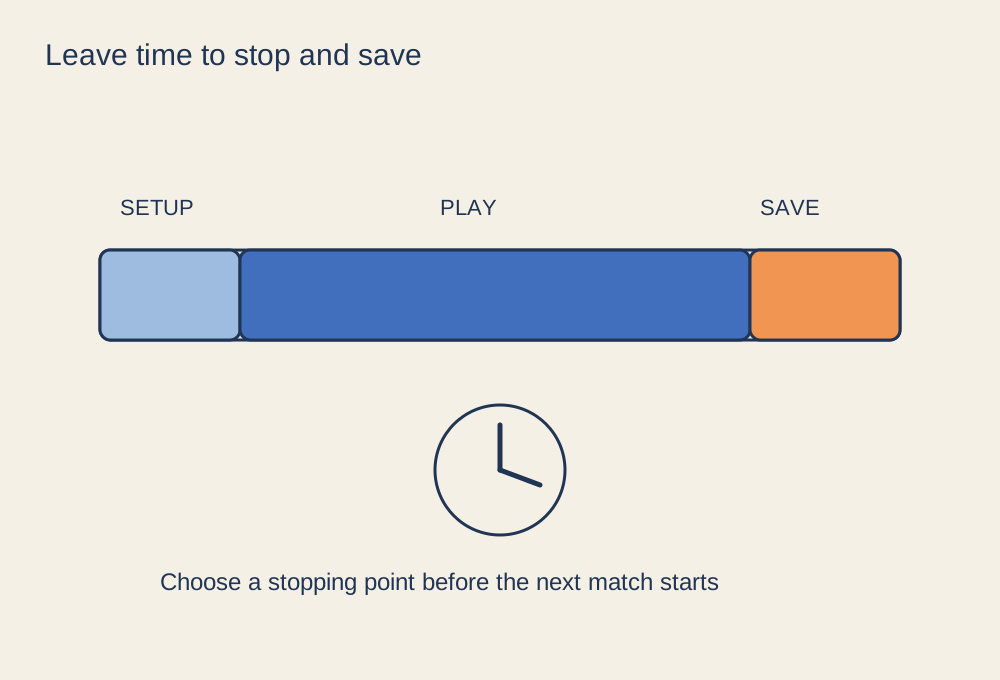
A free hour is not always an hour of play. Updates, joining friends, adjusting settings and reaching a save point can all use part of it. Before starting, check whether the game is ready and how much time remains after those tasks. For a short session, a familiar activity may be more satisfying than beginning a long tutorial you cannot finish.
Choose a stopping point as well as a starting point. It might be one mission, a short route or a small building task. In games with unpredictable match lengths, leave a buffer rather than assuming that the shortest possible round is typical. Avoid joining a group activity that you already expect to abandon before it ends.
Make the plan visible to the group
Tell friends when you need to leave before everyone commits to an activity. That gives the group time to choose a shorter mode or arrange a replacement where the game supports it. A clear departure time is easier to plan around than repeated promises of “one more” followed by a sudden exit.
For a solo game, find out how saving and pausing work. A suspended application is not always the same as a completed save, and an online world may continue while you are away. Use the supported save and quit process rather than relying on an assumption from another game.
Finish in a way that helps next time
Leave a few minutes to save, quit normally and let any relevant cloud synchronisation complete. Note the next task if the game does not make it obvious. A sentence about the current objective can turn the next short session into play instead of a long attempt to remember what you were doing.
If the planned activity regularly exceeds the available time, change the activity rather than making every session run late. Keep a couple of shorter alternatives in mind. The plan does not need to be rigid or optimise every minute; its purpose is to let you enjoy a session and stop without losing progress or leaving other players unexpectedly short-handed.